Antminer Colocation Services That Protect Uptime
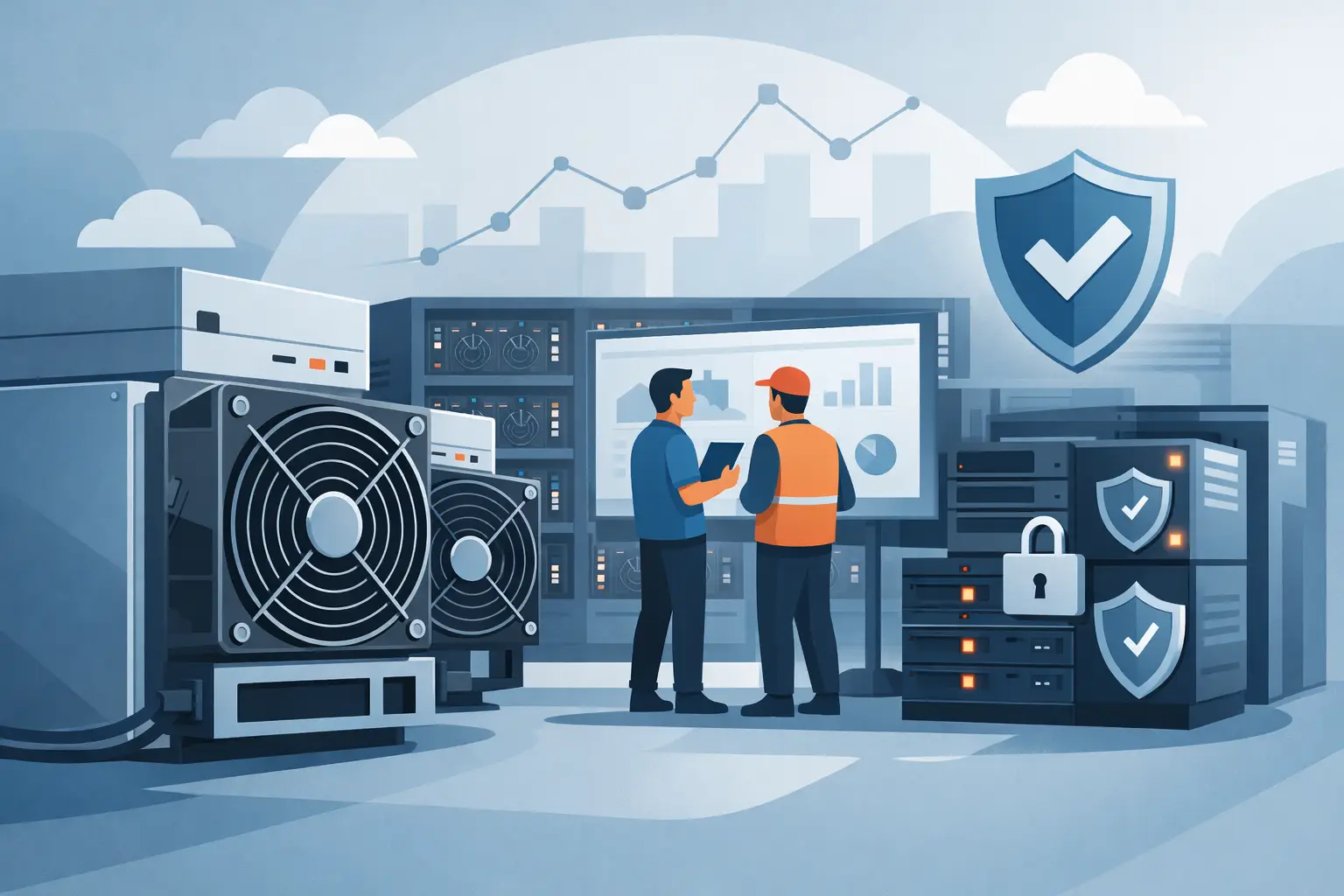
An Antminer can be profitable on paper and still become a poor operating asset in the wrong environment. A few hours of heat stress, unstable power, poor airflow, or delayed repair can erase the advantage of a favorable purchase price. Antminer colocation services move the machine into infrastructure built to keep it hashing, while the owner retains the economic exposure to the hardware and its Bitcoin production.
For individual owners, this removes the noise, heat, electrical load, and daily troubleshooting that make home mining difficult. For fleet operators, it replaces fragmented facility management with measurable uptime, defined operating processes, and a team that can act when a miner stops performing. The right colocation provider is not simply renting rack space. It is operating the conditions that determine whether your ASIC fleet earns consistently.
What Antminer Colocation Services Should Include
At a minimum, colocation means your Antminer is installed in a professional mining facility rather than at your home, office, or warehouse. The provider supplies the power distribution, cooling environment, network connectivity, physical security, and on-site operations. Your machine supplies hashrate.
That definition is simple, but the quality of service varies widely. A low advertised electricity rate does not tell you whether the facility can handle summer temperatures, whether technicians can diagnose a failing hashboard, or whether production data is accessible when you need it. Those details have a direct effect on realized revenue.
A professional setup begins with power. ASICs draw continuous, high loads, and they need electrical infrastructure designed for that duty cycle. The facility should have properly sized distribution, circuit protection, monitoring, and a clear process for responding to power events. Ask whether quoted energy pricing includes applicable hosting costs, or whether management, maintenance, pool, and withdrawal charges appear separately later.
Cooling matters just as much, particularly in hot climates. Antminers are designed to operate within specified temperature ranges, but stable intake conditions and effective heat removal determine how hard fans need to work and how often components are stressed. Industrial ventilation, containment, filtration, and cooling architecture should be engineered for the local climate, not added after the miners arrive.
Network and pool operations also belong in the service scope. A hosting operator should configure firmware and pool connectivity correctly, monitor worker status, and identify meaningful hashrate deviations. That does not mean every brief dip requires intervention. Mining pools, block luck, and normal device behavior can affect short-term figures. It does mean prolonged offline time, repeated errors, or a machine hashing materially below its expected range should be visible and addressed.
Why Uptime Is More Than a Marketing Number
A facility may advertise 99% uptime, but miners should understand what that figure represents. Is it site power availability, internet availability, or actual machine-level hashing availability? Is scheduled maintenance included? What happens when one Antminer is offline while the rest of the site is running?
For an owner, machine-level performance is the relevant measure. A fleet can have access to excellent site infrastructure yet lose revenue if several units are waiting days for a fan replacement or hashboard diagnosis. This is why on-site technical capability is valuable. Repair capacity reduces the time between failure detection, diagnosis, parts replacement, testing, and redeployment.
There is also a practical trade-off. Premium facilities with strong power systems, climate controls, technicians, and reporting may cost more than basic warehouse hosting. The decision should be based on total operating economics, not the headline hosting price. A lower rate is only cheaper if it does not create enough downtime, curtailment, or repair delay to outweigh the savings.
For larger fleets, ask for reporting that distinguishes active, offline, under-repair, and pending-installation units. For a single unit, clear access to hashrate and payout data may be enough. The reporting depth should match the capital at risk.
Hardware Compatibility and Condition
Not every Antminer has the same economics or facility requirements. An older S19-series unit may be viable at a competitive energy rate but become uneconomic sooner if Bitcoin difficulty rises or market price falls. Newer, more efficient models generally tolerate higher power costs better, but require more upfront capital.
Before shipping hardware, confirm that the provider accepts the exact model, power profile, and firmware configuration. Ask whether it hosts air-cooled equipment only or can support hydro-cooled units, which need different infrastructure. You should also document serial numbers, condition, accessories, and ownership before intake. A professional provider should inspect incoming units and record their status before deployment.
Evaluate the Full Cost of Mining, Not Just Electricity
Electricity remains the largest operating expense for most ASIC miners. Still, the number that matters is your all-in cost per operating machine. A meaningful quote should make it possible to understand energy charges, hosting fees, installation, remote hands, repair labor, replacement parts, pool fees, and any payout or withdrawal charges.
Bitcoin mining revenue is variable. It changes with Bitcoin price, network difficulty, transaction fees, pool performance, and the actual efficiency of your machine. No colocation provider can remove that market exposure. What it can do is give you clearer operating costs and reduce avoidable losses caused by unreliable infrastructure.
Downside-aware energy pricing can be especially useful when market conditions tighten. MinersME operates a BTC price-protected energy model that caps electricity at $0.05 per kWh when Bitcoin trades below $80,000. For an owner running eligible hardware, that structure can make energy costs more predictable precisely when mining margins face the most pressure. As with any commercial term, confirm eligibility, included services, and the contract conditions before committing equipment.
Do not compare a fixed monthly hosting charge with a per-kWh price as if they were equivalent. Convert each offer into an expected monthly operating cost using your Antminer’s real power draw, then test the result under several revenue scenarios. Include a conservative case where difficulty increases or Bitcoin price declines. If the machine only works in the most optimistic case, colocation cannot fix the underlying economics.
Questions to Settle Before You Ship
The best time to clarify operations is before a miner leaves your possession. Start with ownership and custody. You should know who controls pool credentials, whether you can change payout addresses, and how Bitcoin withdrawals work. Hosting should not require giving up ownership of your ASIC or unnecessary control over your mined BTC.
Then establish the service process. Ask how installation is confirmed, when billing begins, what triggers a support ticket, and who authorizes paid repairs. A good provider will explain whether it can perform board-level repair, how it prices replacement components, and whether you receive approval before material costs are incurred.
Payout accounting deserves the same attention. Depending on the pool arrangement, rewards may be calculated under PPS, PPS+, or FPPS. PPS generally pays for submitted shares at a defined rate, while PPS+ and FPPS can incorporate transaction-fee income differently. None is automatically best in every situation. What matters is that the payout method, pool fee, reporting period, and settlement process are stated clearly.
Finally, review logistics and exit terms. Equipment may need customs documentation, insured shipping, and careful packaging. Ask how quickly hardware can be released if you choose to relocate it, sell it, or upgrade the fleet. Long lockups can be acceptable when they are offset by better economics, but they should be understood rather than discovered later.
A Better Operating Model for Owners and Fleet Managers
Colocation works best when responsibilities are explicit. The owner decides which hardware to deploy, sets the commercial objective, monitors economics, and maintains control of account and payout details. The hosting operator keeps the environment stable, watches machine health, performs approved interventions, and reports what is happening on the floor.
This separation lets each side focus on its actual expertise. You do not need to become an HVAC technician or build a high-load electrical system to own Bitcoin mining hardware. At the same time, you should not treat hosting as a black box. Review production regularly, compare actual hashrate against expected performance, and ask questions when results differ materially from the machine’s normal range.
Start with a provider that can show how it handles the unglamorous parts of mining: intake inspection, power events, heat management, failed fans, damaged boards, firmware issues, pool configuration, security, and payouts. Those operating details are where an Antminer becomes a durable income-producing asset rather than a loud machine waiting for the next problem.