Hosted Mining Versus Home Mining: What Pays Off?
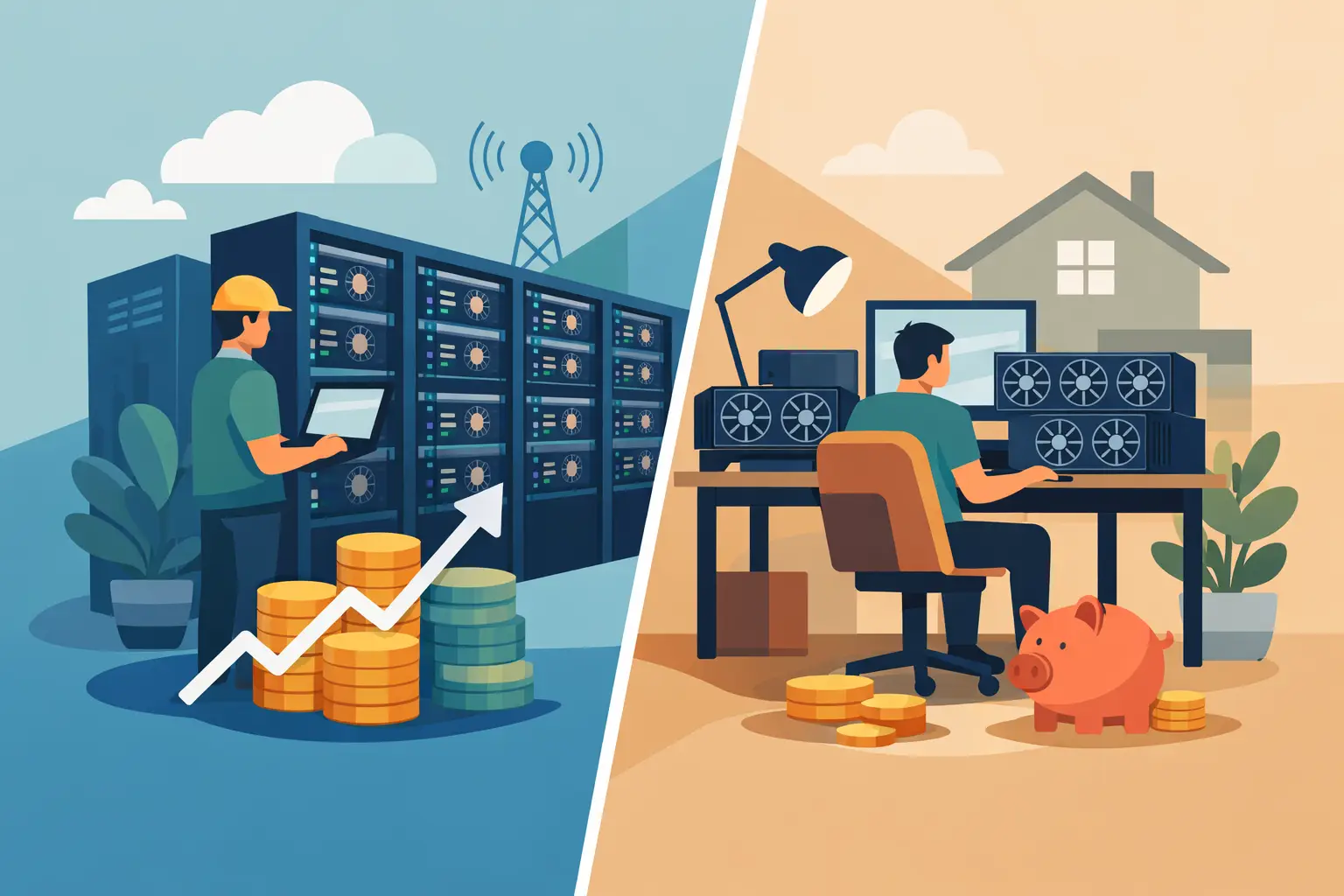
A modern Bitcoin ASIC can turn a spare room into a 75-decibel heat source, push a household circuit past its limits, and require attention the moment a fan, power supply, or network connection fails. That is the practical starting point for hosted mining versus home mining. The right choice is not simply about where an ASIC sits. It is about whether your power rate, technical capacity, and available time can support a mining operation that must run continuously to compete.
For some miners, running hardware at home remains a sensible way to learn the mechanics of Bitcoin mining or use unusually cheap electricity. For most people buying current-generation ASICs for consistent production, professional hosting provides a more predictable operating environment. The decision should be made with real costs and operational constraints in view, not just a hardware price or a projected daily payout.
Hosted Mining Versus Home Mining: The Core Difference
Home mining means you buy, install, power, cool, configure, and maintain the ASIC yourself. You control the machine directly, choose the pool, manage the wallet, and handle every interruption. That can be appealing to hands-on miners who have suitable space, electrical infrastructure, and a power rate low enough to remain competitive.
Hosted mining, often called colocation, means you own the ASIC but place it in a professional mining facility. The hosting operator supplies the industrial power distribution, cooling, connectivity, monitoring, physical security, and on-site technical support. You retain economic exposure to the machine's hashrate while the facility handles the environment needed to operate it at scale.
This differs from buying cloud hashrate or a mining contract. With hosted mining, you generally own a specific physical ASIC. With a hashrate contract, you purchase access to a defined amount of mining power without owning or managing the underlying hardware. Both can remove the burden of operating equipment at home, but they have different capital requirements, ownership structures, and exit options.
The Cost Question Is Bigger Than Electricity
Electricity is the first number miners compare, and it should be. A high-efficiency ASIC can consume roughly 3,000 to 4,000 watts around the clock. At residential rates, that consumption can quickly make the machine unprofitable, especially when Bitcoin price, network difficulty, or transaction-fee revenue changes.
But the rate on a utility bill is not the whole cost of home mining. A serious setup may require a dedicated electrical circuit, upgraded wiring, ventilation changes, ducting, sound treatment, or an external enclosure. In hot climates, air conditioning adds another layer of energy use. If the machine trips a breaker, overheats, or goes offline while you are away, the lost production is also a cost.
Professional facilities spread infrastructure expense across many machines. They can procure power at commercial scale, use purpose-built airflow design, and maintain redundant network systems. The result is not guaranteed profitability - no mining model can guarantee that - but it can provide a clearer view of operating costs.
A downside-conscious energy structure matters most when market conditions tighten. For example, MinersME applies a BTC price-protected energy model that caps electricity at $0.05/kWh when Bitcoin trades below $80,000. That type of pricing does not remove mining risk, but it directly addresses one of the largest variables in an ASIC owner's operating model during a downturn.
Ask what the quoted rate includes
When evaluating a host, confirm whether the stated electricity price includes facility overhead, cooling, rack space, pool setup, monitoring, remote hands, and routine maintenance. A low headline rate can be less useful if recurring fees appear elsewhere or if downtime response is unclear.
For home mining, calculate the all-in rate after additional cooling and electrical consumption. The number that matters is the cost to produce each unit of hashrate reliably, not just the rate printed by the utility.
Uptime Is a Revenue Variable
Mining revenue is earned only while the ASIC is hashing. A machine that is offline for a day due to a router failure, heat issue, firmware error, or broken fan does not make up that lost time later. This is why uptime deserves the same scrutiny as energy cost.
At home, uptime depends on your internet connection, electrical stability, room temperature, and ability to respond. A brief power event may require you to restart equipment. Dust buildup can reduce cooling performance. A failed fan can become a larger repair if it is not noticed quickly. These are manageable problems for a technically capable owner, but they require attention.
A professional host can monitor fleet health 24/7, identify underperforming machines, and dispatch technicians without waiting for the owner to notice a lower hashrate reading. Industrial cooling also keeps intake temperatures and airflow within a more controlled range than most garages, warehouses, or residential rooms can provide.
Do not treat a published uptime figure as a substitute for due diligence. Ask how uptime is measured, what events are excluded, who pays for repairs, and how the operator communicates outages. A reliable facility should be able to explain its monitoring process, maintenance workflow, and reporting without vague promises.
Heat, Noise, and Electrical Safety at Home
The physical reality of an ASIC is often underestimated. A typical high-performance miner produces continuous fan noise comparable to loud shop equipment. It also exhausts enough heat to make a small room uncomfortable or unsafe without proper ventilation. Closing the machine in a cabinet without engineered airflow can create overheating problems rather than solve the noise issue.
Electrical safety is equally important. ASICs are continuous loads, not occasional appliances. The circuit, breaker, outlet, plug type, cable rating, and grounding must match the machine's requirements. Improvised wiring, overloaded extension cords, and poor ventilation are not acceptable trade-offs for a few extra terahashes.
Home mining can work best when the miner has a separate, appropriately wired area, low-cost power, cool ambient conditions, and the ability to use the generated heat productively. In a cold climate, directed ASIC heat may offset part of a heating bill. In a hot region, however, removing that heat can become expensive and impractical.
Control Does Not Have to Mean Doing Every Task Yourself
One argument for home mining is control. You can see the machine, hear when something changes, and decide exactly how it is configured. That control is real, but it is worth separating ownership from manual labor.
With quality hosting, you can retain ownership of your hardware and visibility into its performance while outsourcing facility operations. Look for live hashrate reporting, clear payout records, pool and firmware configuration options, and a defined process for authorizing repairs or moving equipment. Non-custodial BTC withdrawals are particularly relevant for miners who want production paid directly to a wallet they control.
The strongest hosting model gives you operational visibility without requiring you to become the on-call facility manager. That balance is especially useful for fleet owners managing multiple ASICs across borders or investors who want Bitcoin mining exposure but do not want a data center in their home.
Maintenance and Repair Change the Economics
ASICs are built for hard, continuous work. Fans wear out, power supplies fail, hashboards develop faults, and firmware may need updating. A small repair delay can become meaningful when a machine is producing revenue every day.
At home, you must diagnose the problem, source parts, decide whether a repair is economical, and ship the unit to a specialist when necessary. Shipping a heavy ASIC also introduces cost, transit time, and risk.
At a hosted facility with an in-house repair capability, technicians can inspect and service machines close to where they operate. That does not mean every unit will be repaired instantly or at no cost. It means the path from fault detection to diagnosis is shorter, and the machine does not need to travel across countries for routine service.
Before committing, ask for the repair authorization process. Find out whether the operator uses original or approved replacement parts, how repair costs are quoted, and whether owners can access historical service records for each unit.
Which Setup Fits Your Mining Plan?
Home mining may be the better choice if you already have exceptionally low power costs, suitable industrial-grade electrical capacity, a noise-tolerant location, and the technical interest to manage equipment directly. It can be educational and gives you immediate physical access to your machines. It is less suitable for someone expecting passive income from an ASIC placed beside a home office or in an apartment.
Hosted mining is usually the stronger option for owners who value stable infrastructure, controlled cooling, professional monitoring, and freedom from day-to-day facility work. It is also more practical for scaling from one machine to a fleet, where a single household connection and electrical panel are unlikely to support the load safely.
If buying hardware is not the right starting point, smaller hashrate purchases or mining-linked contracts can offer another entry point. They reduce operational complexity and upfront hardware commitment, though buyers should still understand fees, payout methodology, contract terms, and the fact that mining returns fluctuate.
The best decision is the one you can operate through both strong and weak market conditions. Price the electricity honestly, plan for downtime and repairs, verify how payouts are calculated, and choose an environment built to keep your hashrate working when it matters.