Cloud Mining Versus ASIC Ownership Compared
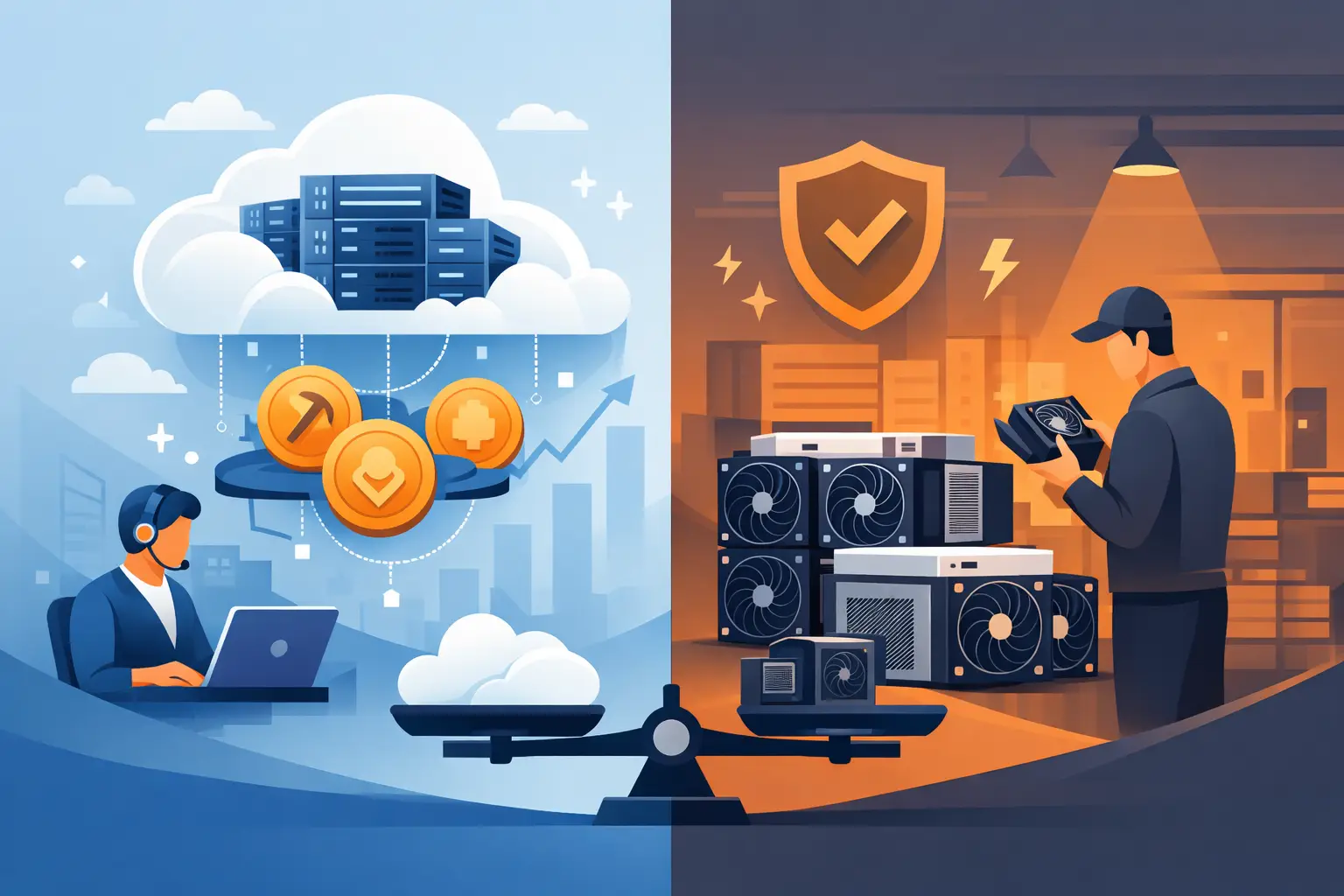
A mining decision often starts with a practical constraint, not a market prediction. You may want Bitcoin production without a hot, noisy machine at home, or you may already own ASICs and need a facility that can operate them properly. In cloud mining versus ASIC ownership, the better route depends on how much capital, operational responsibility, and direct control you want to carry.
Both models can provide exposure to Bitcoin mining. They do not provide the same rights, risks, or level of visibility. A clear comparison starts with understanding what you are actually buying.
What you own in each model
With cloud mining, you buy a defined amount of hashrate for a defined period or under a stated contract structure. The provider operates the machines, manages power, cooling, pool configuration, monitoring, repairs, and facility security. Your return is generally calculated from the hashrate allocated to you, the pool payout method, network conditions, Bitcoin price, and the fees specified in the agreement.
You are not usually buying a specific Antminer or WhatsMiner. That distinction matters. You are buying production exposure, not a physical asset you can inspect, relocate, resell, or reconfigure.
With ASIC ownership, you purchase the machine itself. You control the hardware decision, including model, efficiency, age, firmware strategy, pool selection, and eventual resale or redeployment. If the ASIC is hosted, a professional facility handles the physical operating environment while you retain ownership of the unit and the Bitcoin it produces, subject to the hosting agreement.
This makes ASIC ownership a more direct form of mining participation. It can also involve more decisions before and after the purchase.
Cloud mining versus ASIC ownership: the core trade-off
Cloud mining lowers the entry barrier. A customer can start with a small hashrate allocation rather than funding an entire machine, international shipping, electrical infrastructure, and deployment. It is particularly useful for someone who wants daily BTC exposure but does not want to manage hardware.
ASIC ownership gives the miner more control and a potentially longer-term asset position. The owner can choose when to buy, sell, upgrade, repair, or move the unit. That flexibility has value, especially for experienced miners who understand hardware cycles and have a clear view of their operating horizon.
The trade-off is simple: cloud mining exchanges direct ownership for convenience, while ASIC ownership exchanges convenience for control. Neither model removes mining risk. Bitcoin price, network difficulty, transaction-fee conditions, equipment efficiency, and energy costs still shape the economics.
Upfront capital and the ability to scale
Cloud mining is designed for incremental participation. If your goal is to test mining economics or build a small daily BTC allocation, starting with a modest hashrate purchase can be more practical than committing to one full ASIC. It also avoids the common problem of buying a machine that is too large a commitment for your available capital.
This does not mean cloud mining is automatically cheaper. The contract price needs to be assessed against its hashrate, duration, payout terms, maintenance charges, curtailment rules, and withdrawal conditions. A low entry price may be attractive, but the real question is how much productive hashrate you receive and under what operating assumptions.
ASIC ownership generally requires more capital upfront. Beyond the machine cost, miners should account for transport, import requirements where applicable, installation, hosting setup, deposits, and a reserve for repairs or replacement parts. For a fleet buyer, those expenses can be justified by stronger hardware control and scale. For a first-time miner, they can be a reason to start smaller.
Operating responsibility is not a minor detail
Mining hardware is an industrial workload. An ASIC does not simply need electricity. It needs stable power delivery, engineered cooling, network uptime, pool connectivity, dust control, security, and regular attention to hashboard, fan, and power-supply faults. These requirements become more demanding in hot climates.
A credible cloud mining provider absorbs those operational tasks. That is the central value proposition, not just the absence of a physical machine. The provider should be able to explain how hashrate is sourced, how production is measured, which payout method applies, what fees are covered, and how downtime is handled.
Hosted ASIC ownership also removes most facility work, but it does not remove ownership decisions. The owner may need to authorize repairs, decide whether an aging unit is worth maintaining, and determine when efficiency no longer supports continued operation. A full-stack hosting operator with monitoring, repair capability, cooling infrastructure, and transparent reporting can reduce that burden substantially.
Control, transparency, and custody
Control is often the deciding factor for established miners. An ASIC owner can identify the exact units in a fleet, track individual hashrate, review downtime, and make hardware-specific decisions. Where the arrangement supports it, the owner can also direct mining output to a wallet under their own control.
Cloud mining customers should focus on a different set of transparency questions. How frequently are payouts calculated? Are they described as PPS, PPS+, or FPPS? Is the displayed hashrate allocated, average, or delivered? Are maintenance and electricity charges already included? Can BTC be withdrawn non-custodially, and are minimum withdrawal limits clearly disclosed?
Clear answers matter more than aggressive yield claims. Mining revenue changes. Any provider presenting a fixed-looking outcome without clearly separating contract terms from variable Bitcoin mining conditions deserves careful scrutiny.
Energy risk can decide profitability
For ASIC owners, electricity is usually the largest ongoing operating cost. A highly efficient machine can still become uncompetitive if energy pricing rises while Bitcoin price falls or network difficulty increases. This is why the headline hosting rate is not enough. Miners need to understand the pricing model, whether it can change, and what protection exists during weaker market conditions.
A downside-conscious model can materially improve planning. For example, a BTC price-protected energy structure that caps electricity at $0.05 per kWh when Bitcoin trades below $80,000 helps limit one of the most painful forms of operating pressure. It does not guarantee profit, but it makes the cost side less exposed when market conditions deteriorate.
Cloud mining bundles energy exposure differently. The customer may see an all-in contract price, a daily maintenance deduction, or another defined fee mechanism. That can make cash flow easier to understand, but only if the provider states the formula plainly. Ask what happens if power costs change, machines require replacement, or network conditions make production uneconomic.
When cloud mining makes more sense
Cloud mining is usually the better fit when you want a low-friction entry point, do not want to own equipment, and value predictable administration over machine-level control. It can also work for investors who prefer to allocate capital across several Bitcoin strategies rather than committing a large share to depreciating hardware.
It is especially practical when home mining is unrealistic. Residential power pricing, heat, noise, limited electrical capacity, and maintenance demands can turn a theoretically profitable machine into an expensive distraction. A professionally operated hashrate contract eliminates those household constraints.
The key is provider selection. Look for real operating infrastructure, transparent payout reporting, understandable fees, clearly defined withdrawal rules, and a track record that can be evaluated beyond marketing language.
When ASIC ownership makes more sense
ASIC ownership is better suited to miners who want a tangible asset and are prepared to think in machine cycles rather than short contract periods. It can be compelling for buyers with enough capital to acquire efficient units, a longer time horizon, and confidence in a hosting partner's operations.
It is also the natural route for existing miners expanding a fleet. They may want specific hardware models, direct pool configuration, fleet-level telemetry, repair decisions under their control, and the option to sell units if market conditions change. For these customers, colocation can provide industrial infrastructure without giving up asset ownership.
At MinersME, that distinction is practical: customers can begin with small hashrate exposure or host owned ASICs in a professionally managed UAE environment. The right starting point is based on capital and control, not on forcing every miner into the same product.
Make the decision with a realistic time horizon
Before committing, define whether you are seeking a small daily BTC allocation, a long-term hardware position, or operational scale. Then compare the full cost and control profile, not just the projected payout number. A cloud contract should be judged by its terms and transparency. An ASIC purchase should be judged by machine efficiency, hosting economics, repair support, energy protection, and residual value.
The strongest mining setup is the one you can understand, fund, and hold through changing conditions. Start at the level of responsibility you can genuinely manage, then scale when the operating model has earned your confidence.