Hashrate Versus Cloud Mining for Bitcoin
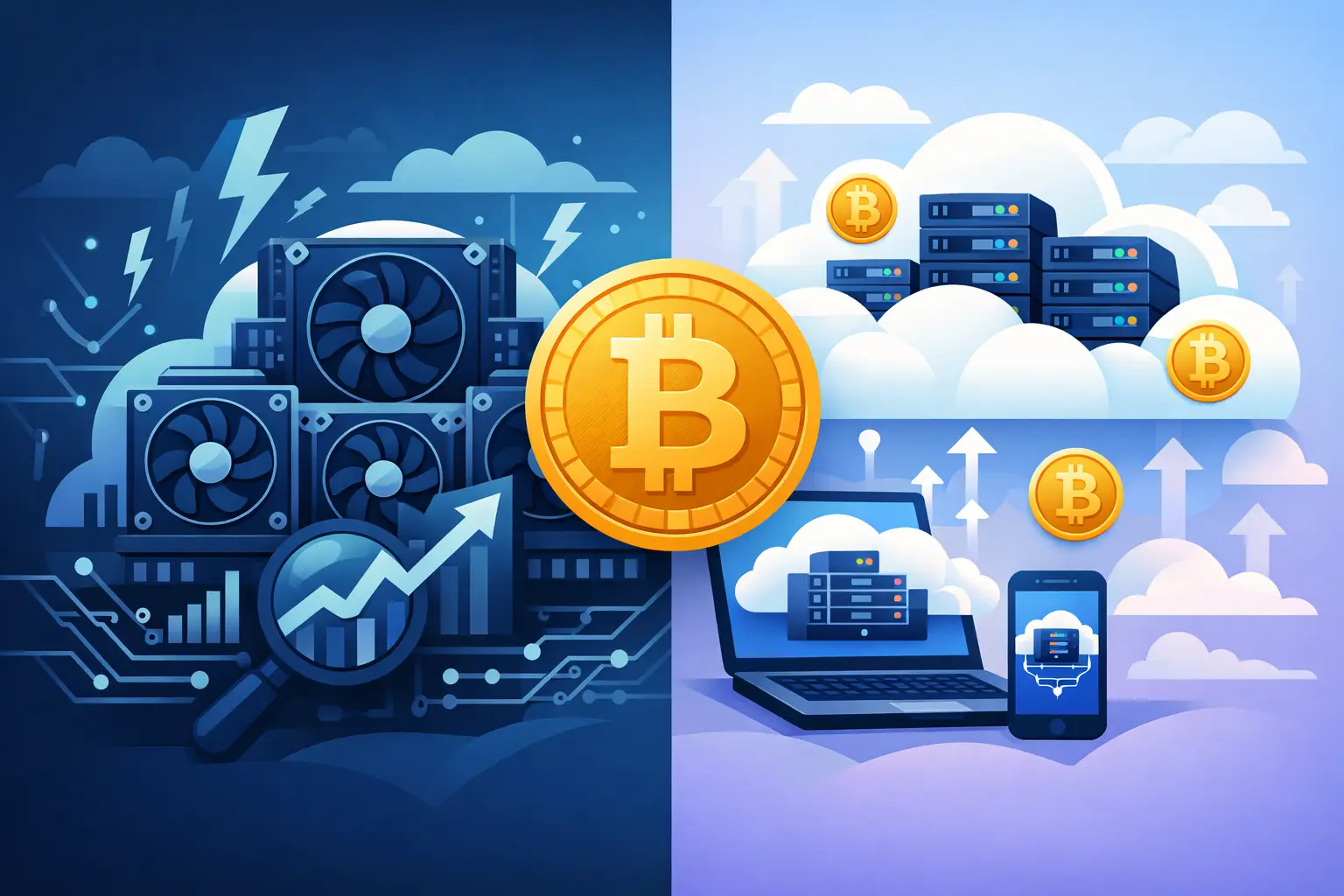
A miner shopping for Bitcoin exposure may see hashrate packages next to cloud mining contracts and assume they are competing products. In reality, hashrate versus cloud mining is not a clean either-or comparison. Hashrate is the computing work that secures Bitcoin and earns mining rewards. Cloud mining is one way to access that work without operating an ASIC at home.
That distinction matters because it changes the questions you should ask. Do you want to own a specific machine? Do you want daily BTC production without handling hardware? Are you evaluating a payout contract, or purchasing a defined amount of mining capacity? The right route depends on your capital, technical appetite, expected holding period, and tolerance for operational variables.
What Hashrate Actually Means
Hashrate measures how many cryptographic calculations mining hardware can perform each second. Bitcoin mining capacity is commonly expressed in terahashes per second, or TH/s. A modern ASIC may produce hundreds of TH/s, while a small hashrate purchase can give a customer exposure to a fraction of that output.
More hashrate generally means a larger share of potential block-reward production. It does not mean a fixed amount of Bitcoin each day. Your actual output also moves with Bitcoin network difficulty, transaction-fee conditions, pool performance, uptime, firmware settings, and the payout method used by the pool.
For example, 100 TH/s represents a defined amount of computing power. Its BTC output will change as the network changes. If network difficulty rises, that same 100 TH/s earns less BTC before operating costs than it did previously. If difficulty falls, the opposite may occur.
Hashrate is therefore the productive unit. It is comparable to capacity in a factory, not the factory lease, power contract, maintenance team, or ownership structure behind it.
What Cloud Mining Means
Cloud mining is a service model. A provider operates the mining infrastructure - ASICs, power systems, cooling, networking, security, pool connections, and maintenance - while the customer buys access to mining output under stated contract terms.
The customer does not need to receive a machine, wire a high-load electrical circuit, manage heat, replace fans, diagnose hashboards, or respond to a fault at 2:00 a.m. The provider handles the facility work and reports production and settlement according to the agreement.
Cloud mining can be structured in several ways. A contract may allocate a fixed amount of hashrate for a set period. It may use a revenue-sharing model. It may quote projected returns after fees, or offer a fixed-return product that is mining-linked but behaves differently from direct mining output. These are not interchangeable. Read the commercial terms before comparing headline numbers.
A genuine cloud mining offer should clearly explain the hashrate allocation or return methodology, contract duration, fees, payout schedule, withdrawal rules, and what happens if mining economics deteriorate. If those details are vague, the advertised daily figure is not enough to evaluate the offer.
Hashrate Versus Cloud Mining: The Real Comparison
The practical choice is usually between purchasing or owning hashrate through different operating models.
When you buy hashrate directly through a managed provider, you are purchasing a measurable share of mining capacity. Your results should track the production of that capacity, subject to the stated payout model and deductions. This can be a straightforward route for someone who wants mining exposure starting at a smaller amount, including customers who want to test the process before committing to hardware.
When you enter a cloud mining contract, you are buying a service relationship around mining. The contract may be based on hashrate, but it can also include bundled power, hosting, maintenance, administration, and risk-management provisions. The provider's operational quality becomes central to the value of the contract.
Neither model removes Bitcoin mining risk. Bitcoin price can fall, network difficulty can rise, and contract economics can change. The difference is where operational responsibility sits. With managed hashrate or cloud mining, the operator carries the day-to-day facility burden. With self-owned equipment, you carry more direct control and more direct exposure to downtime, repairs, energy pricing, and logistics.
Where Physical ASIC Ownership Fits
Physical ASIC ownership is a third path that is often confused with cloud mining. You purchase a specific Antminer, WhatsMiner, or other compatible unit, then either operate it yourself or place it in a professional hosting facility.
Home mining can make sense for technically capable operators with suitable power pricing, ventilation, noise tolerance, and the ability to maintain equipment. For most residential users, those conditions are difficult to achieve. A single modern ASIC creates significant heat and noise, draws substantial power continuously, and requires reliable internet and monitoring.
Colocation gives hardware owners a different balance. You retain ownership of the ASIC and receive the production associated with it, while a professional operator manages the data center environment. This is typically better suited to miners who want identifiable hardware, longer-term control, and the ability to scale a fleet without building their own facility.
The trade-off is that hardware owners still face machine-level realities. ASIC efficiency declines relative to newer generations, hashboards can fail, and resale value may change. A credible hosting arrangement should make power charges, uptime reporting, repair procedures, pool configuration, and settlement visibility clear from the start.
Compare the Economics, Not Just the Daily Estimate
Projected BTC earnings are useful, but they are only one line in the decision. Compare the total economic model.
For a hashrate purchase or cloud mining contract, identify the amount of TH/s, contract duration, all-in service fees, maintenance coverage, payout frequency, and whether the quoted figure is gross or net. Ask whether the payout follows PPS, PPS+, or FPPS. These pool methods distribute rewards differently, particularly when transaction fees are high.
For owned ASICs, add the machine price, shipping, import exposure where applicable, installation, electricity, hosting, pool fees, repair reserve, and downtime risk. A lower machine price does not always produce a lower cost per mined Bitcoin if the unit is less efficient or the power rate is unstable.
Energy pricing deserves special attention. Electricity is the largest controllable operating cost in Bitcoin mining, and a fixed rate is not automatically the best rate if it does not reflect market conditions. A downside-conscious structure can be valuable when BTC price weakens. For example, MinersME uses a BTC price-protected energy model that caps electricity at $0.05/kWh when Bitcoin trades below $80,000, helping customers assess mining economics with greater clarity during downturns.
Questions to Ask Before You Commit
Start with custody. Confirm how and when BTC is settled, whether you can withdraw to a wallet you control, and whether the provider has a clear record of daily production reporting. Non-custodial withdrawals matter because mining income should remain accessible to the customer, not trapped inside an opaque platform.
Then look at the operating proof. A facility should be able to explain where equipment runs, how it handles heat, how it monitors uptime, and who repairs failed machines. In the UAE and wider GCC, cooling design is not a marketing detail. It is fundamental infrastructure. Industrial cooling, stable connectivity, spare parts, and 24/7 response directly affect realized hashrate.
Finally, match the product to your objective. A small hashrate allocation can be appropriate if you want daily BTC exposure without hardware management. A cloud mining contract may fit if its terms are transparent and its service structure matches your time horizon. Hosted ASIC ownership may be the better choice if you want direct asset ownership and the ability to build a larger operation.
Choose the Level of Control You Will Actually Use
The best mining model is not the one with the most impressive projection. It is the one whose risks, costs, and operating responsibilities you understand before funds are committed. If you value simplicity, choose transparent hashrate access with clearly reported production. If ownership and fleet control matter more, use professional hosting built for continuous ASIC operation. The productive asset is hashrate; the quality of the infrastructure behind it determines how much of that potential reaches your wallet.