Why Do ASIC Miners Fail? Causes and Prevention
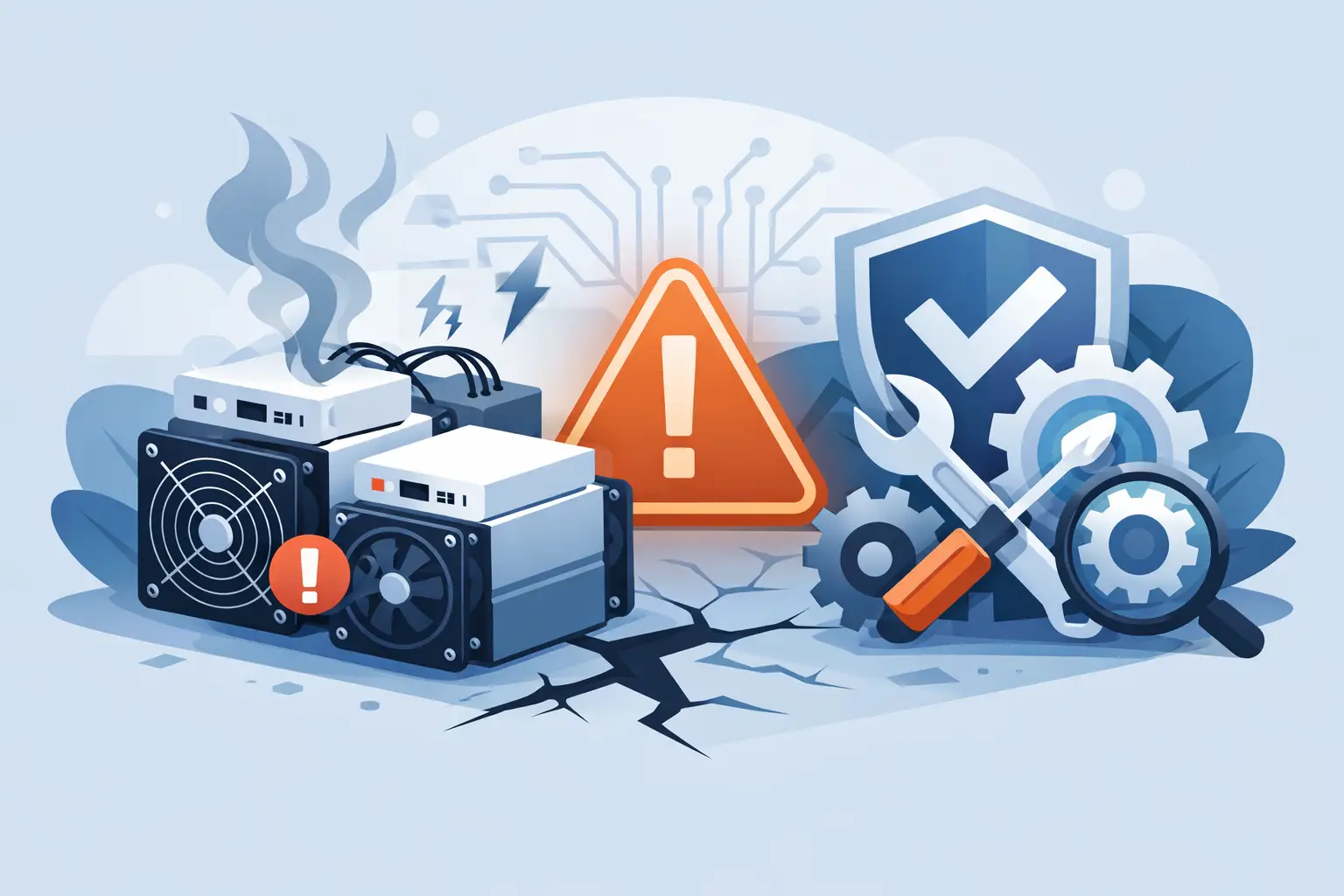
A miner can appear healthy at breakfast and be offline by lunch: hashrate drops, a board disappears from the status page, or the unit starts cycling through reboots. For operators asking why do ASIC miners fail, the answer is rarely a single defective part. Most failures begin with an operating condition - heat, unstable power, contamination, poor airflow, or an unresolved alert - and become expensive when that condition persists.
ASICs are specialized computers built to perform one task at extraordinary intensity. They run continuously, draw substantial current, and produce concentrated heat. That makes them productive when the facility is engineered correctly, but far less forgiving than a typical server or home appliance. Understanding the failure chain helps miners protect hardware value, reduce downtime, and make better decisions about where a fleet should operate.
Why Do ASIC Miners Fail in Real Operating Conditions?
The most common root cause is thermal stress. Every hashboard contains dozens or hundreds of chips operating in close proximity. If heat is not removed consistently, chip temperatures rise, solder joints expand and contract, fans work harder, and the control system may reduce frequency or shut the miner down. A single hot aisle, blocked intake, or weakening fan can create conditions that affect a full board.
Ambient temperature is only part of the equation. Airflow volume, pressure balance, rack layout, recirculation, filter condition, and humidity all influence the temperature the chips actually experience. In a hot climate, relying on room ventilation alone is not a cooling strategy. Industrial cooling and containment must be designed for the heat load of the installed fleet, including peak conditions and equipment degradation over time.
Power quality is the second major contributor. ASIC power supplies are designed for demanding work, but they still need stable voltage, correctly sized circuits, sound grounding, and protection from surges. Undervoltage can cause repeated restarts or unstable hashing. Voltage spikes and poor connections can damage a power supply unit, cables, connectors, or sensitive components on the control board.
Electrical problems are sometimes misdiagnosed as miner problems because the visible symptom is a failed machine. If several miners on one circuit reset together, if power supplies fail at an unusual rate, or if connector temperatures are elevated, the facility infrastructure needs investigation. Replacing the ASIC without correcting the source simply repeats the failure.
Dust, Moisture, and Corrosion Are Slow Failures
Dust is not cosmetic. It reduces heat transfer on heatsinks, restricts fan movement, and accumulates on boards and connectors. In environments with fine sand or industrial particulate, contamination can build quickly enough to turn a normal maintenance interval into a risk. A miner may remain online while temperatures gradually climb and efficiency declines.
Humidity and moisture introduce different risks. Condensation, leaks, high humidity, and abrupt temperature changes can lead to corrosion or electrical shorts. Corrosion around connectors and chips may appear minor at first, yet it can cause intermittent faults that are difficult to isolate. These failures often show up as missing chips, unstable hashboards, or errors that disappear temporarily after a reboot.
The correct response depends on the environment. Air filtration, positive-pressure design, regular cleaning, and humidity management all have a role. Excessive cleaning can also cause damage if operators use the wrong tools, introduce static electricity, or disturb heatsinks. Maintenance needs a documented process, not a blast of compressed air whenever output falls.
Firmware and Configuration Can Cause Apparent Failure
Not every failure is physical. Incorrect firmware, interrupted upgrades, incompatible settings, pool connectivity issues, and bad network configuration can take a miner offline or make it appear underperforming. Firmware controls frequency, voltage behavior, fan logic, and communication with the control board. A poorly managed update can create instability even when the hashboards and power supply are healthy.
Overclocking deserves special attention. Raising frequency may increase hashrate in the short term, but it also increases heat, power draw, and component stress. Whether it makes commercial sense depends on electricity pricing, cooling headroom, machine condition, and the value of incremental hashrate. A fleet operating at a controlled, efficient profile can produce better long-term results than a fleet pushed to its limits and frequently under repair.
Pool-side issues can also be mistaken for hardware trouble. Stale shares, rejected shares, weak internet connectivity, DNS errors, or incorrect worker credentials can reduce reported output. A reliable operation compares miner-side logs, pool data, network telemetry, and electrical readings before deciding that a hashboard has failed.
The Failure Pattern Usually Starts Before Shutdown
Most ASIC failures give early warnings. Rising chip temperatures, fan speed pinned at maximum, declining hashrate, recurring hardware errors, repeated reboots, and an increase in rejected shares all deserve attention. The mistake is treating these signals as normal until a miner stops producing entirely.
A disciplined monitoring process identifies anomalies at the fleet and individual-machine level. One unit that produces 10% less than comparable machines may need inspection. A group of units with similar errors may point to airflow, network, or power conditions rather than separate hardware faults. This is where 24/7 monitoring and accurate telemetry change the economics of mining: they shorten the time between a developing problem and a corrective action.
Repair quality matters as much as detection. A proper repair center diagnoses the failed board or component, checks surrounding parts, validates the repair under load, and returns the machine only after stable testing. Replacing a visible component without finding the underlying heat, power, or contamination issue can lead to repeat downtime.
How to Reduce ASIC Miner Failures
No facility can guarantee that electronics will never fail. Fans wear out, power supplies age, manufacturing variation exists, and a large fleet will always need some repair capacity. The objective is to reduce avoidable failures and contain unavoidable ones before they affect revenue.
Start with the operating environment. Each miner should have adequate intake air, clear exhaust paths, clean filtration suited to local conditions, and temperature thresholds that trigger action before thermal protection activates. Rack density should reflect actual cooling capacity, not just available floor space.
Then establish electrical discipline. Use properly engineered distribution, correctly rated cables and breakers, surge protection, grounding, and continuous measurement of load conditions. Inspect connectors for discoloration, looseness, or heat damage. When a unit faults, check the circuit and rack context rather than viewing the miner in isolation.
Finally, maintain a practical service routine. Track fan health, hashboard temperatures, error logs, hashrate variance, and firmware versions. Keep approved spare parts available for common failures, particularly fans and power supplies. Plan firmware changes, test them on a limited group first, and retain rollback procedures. For large fleets, these controls are not administrative overhead - they are part of production management.
Home Mining Versus Professional Hosting
Mining at home can work for experimentation or limited capacity, but the risks increase as the number and power draw of machines grow. Heat, noise, circuit limitations, dust control, internet reliability, and repair access become operational constraints. A miner that is technically profitable on paper can lose that advantage through unplanned downtime or inadequate cooling.
Professional hosting moves those responsibilities into a purpose-built environment with power engineering, cooling, network management, security, monitoring, pool configuration, and repair support. For hardware owners, the trade-off is a hosting fee and less direct physical access to the machine. In return, the operation can be managed around uptime, environmental control, and faster intervention.
MinersME operates this model from the UAE with industrial infrastructure, in-house ASIC repair capability, and live production visibility for hosted miners. For miners evaluating any facility, the key questions are straightforward: How is cooling designed? How is power protected? Who responds to alerts? How are repairs tested? And how clearly can you verify hashrate, uptime, and payouts?
An ASIC miner is not simply a box that produces Bitcoin. It is a high-load industrial asset whose useful life depends on the environment around it. Give it stable power, controlled cooling, clean air, sensible operating settings, and timely repair, and failures become manageable events rather than recurring surprises.